Overige boeken
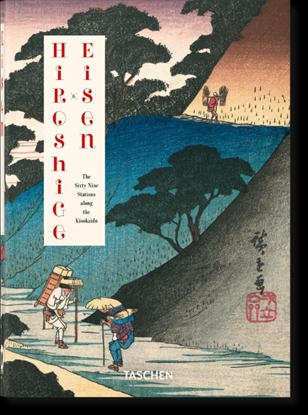
Hiroshige & Eisen. The Sixty-Nine Stations along the Kisokaido. 40th Ed.
The Kisokaidō route through Japan was ordained in the early 1600s by the country’s then-ruler Tokugawa Ieyasu, who decreed that staging posts be installed along the length of the arduous passage between Edo (present-day Tokyo) and Kyoto. Inns, shops, and restaurants were established to provide sustenance and lodging to weary travelers. In 1835, renowned woodblock print artist Keisai Eisen was commissioned to create a series of works to chart the Kisokaidō journey. After producing 24 prints, Eisen was replaced by Utagawa Hiroshige, who completed the series of 70 prints in 1838.
Both Eisen and Hiroshige were master print practitioners. In The Sixty-Nine Stations along the Kisokaidō, we find the artists’ distinct styles as much as their shared expertise. From the busy starting post of Nihonbashi to the castle town of Iwamurata, Eisen opts for a more muted palette but excels in figuration, particularly of glamorous women, and relishes snapshots of activity along the route, from shoeing a horse to winnowing rice. Hiroshige demonstrates his mastery of landscape with grandiose and evocative scenes, whether it’s the peaceful banks of the Ota River, the forbidding Wada Pass, or a moonlit ascent between Yawata and Mochizuki.
Taken as a whole, The Sixty-Nine Stations collection represents not only a masterpiece of woodblock practice, including bold compositions and an experimental use of color, but also a charming tapestry of 19th-century Japan, long before the specter of industrialization. This TASCHEN volume is sourced from one of the finest surviving first editions and revives the series in our compact anniversary edition.

Hiroshige. One Hundred Famous Views of Edo
Utagawa Hiroshige (1797–1858) was one of the last great artists in the ukiyo-e tradition. Literally meaning “pictures of the floating world,” ukiyo-e was a particular genre of art that flourished between the 17th and 19th centuries and came to characterize the Western world’s visual idea of Japan. In many ways images of hedonism, ukiyo-e scenes often represented the bright lights and attractions of Edo (modern-day Tokyo): beautiful women, actors and wrestlers, city life, and spectacular landscapes.
Though he captured a variety of subjects, Hiroshige was most famous for landscapes, with a final masterpiece series known as “One Hundred Famous Views of Edo” (1856–1858), which depicted various scenes of the city through the seasons, from bustling shopping streets to splendid cherry orchards.
This reprint, bound in the traditional Japanese fashion, is made from one of the finest complete original sets of woodblock prints belonging to the Ota Memorial Museum of Art in Tokyo. It pairs each of the 120 illustrations with a description, allowing readers to immerse themselves in these beautiful, vibrant vistas that became paradigms of Japonisme and inspired Impressionist, Post-Impressionist and Art Nouveau artists alike, from Vincent van Gogh to James McNeill Whistler.
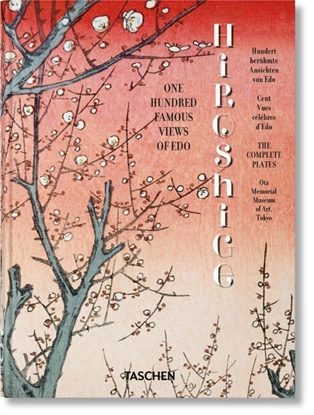
Hiroshige. One Hundred Famous Views of Edo. 45th Ed.
Utagawa Hiroshige (1797–1858) was one of the last great artists in the ukiyo-e tradition. Literally meaning “pictures of the floating world,” ukiyo-e was a particular genre of art that flourished between the 17th and 19th centuries and came to characterize the Western world’s visual idea of Japan. In many ways images of hedonism, ukiyo-e scenes often represented the bright lights and attractions of Edo (modern-day Tokyo): beautiful women, actors and wrestlers, city life, and spectacular landscapes.
Though he captured a variety of subjects, Hiroshige was most famous for landscapes, with a final masterpiece series known as “One Hundred Famous Views of Edo” (1856–1858), which depicted various scenes of the city through the seasons, from bustling shopping streets to splendid cherry orchards.
This reprint is made from one of the finest complete original sets of woodblock prints belonging to the Ota Memorial Museum of Art in Tokyo. It pairs each of the 120 illustrations with a description, allowing readers to immerse themselves in these beautiful, vibrant vistas that became paradigms of Japonisme and inspired Impressionist, Post-Impressionist and Art Nouveau artists alike, from Vincent van Gogh to James McNeill Whistler.
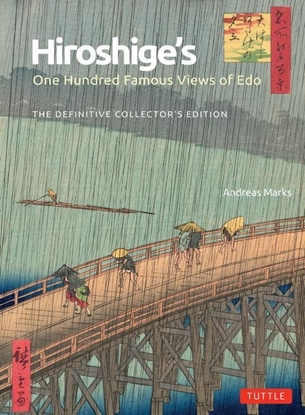
Hiroshige's One Hundred Famous Views of Edo
A landmark book presenting the early "deluxe" versions of Hiroshige's Edo prints for the first time!
Utagawa Hiroshige's unique landscape series One Hundred Famous Views of Edo (modern-day Tokyo), first published in the 1850s, is among the best-known collections of Japanese prints and was revolutionary in its day. Individual prints from this collection are regarded as among the finest works in all of Japanese art.
In this series, Hiroshige captures 118 locations in and around Edo, today's Tokyo, during all four seasons and often from hitherto unknown and unique perspectives. These views were first printed in exquisite luxury versions, incorporating innovative woodblock printing features like color gradation. No complete set of the early versions exists today and this is the first book to present a complete set of the deluxe early printings, sourced from 32 different museums and private collections.
Author Andreas Marks consulted 4,700 prints in order to compile this definitive guide to Hiroshige's One Hundred Famous Views of Edo. Marks presents the various printed versions along with reference images showing how and where Hiroshige sourced his ideas for each viewfrom previous books and illustrations. The result is a definitive guide to understanding the complexity of Hiroshige's great work as well as the dynamics of the Japanese print market during this period.
Marks' introduction discusses the genesis of the series in the context of Japanese landscape art as well as Hiroshige's personal biography. The book then presents all 118 prints together with their source materials and a map showing the locations of each view, followed by a detailed appendix discussing the great color variations found in subsequent printings of the series. Lees meer


His and Hers

His Dark Materials
Fantasy, mystery, war and love - it's all here in the magical trilogy His Dark Materials
This BEAUTIFUL GIFT collection features ALL THREE titles in the award-winning trilogy: Northern Lights, The Subtle Knife and THE AMBER SPYGLASS
The Amber Spyglass
Will and Lyra, whose fates are bound together by powers beyond their own worlds, have been violently separated. But they must find each other, for ahead of them lies the greatest war that has ever been - and a journey to a dark place from which no one has ever returned . . .
Northern Lights
Lyra Belacqua lives half-wild and carefree among the scholars of Jordan College, with her daemon familiar always by her side. But the arrival of her fearsome uncle, Lord Asriel, draws her to the heart of a terrible struggle - a struggle born of Gobblers and stolen children, witch clans and armoured bears.
The Subtle Knife
Lyra finds herself in a shimmering, haunted otherworld - Cittàgazze, where soul-eating Spectres stalk the streets and wingbeats of distant angels sound against the sky. But she is not without allies: twelve-year-old Will Parry, fleeing for his life after taking another's, has also stumbled into this strange new realm.
On a perilous journey from world to world, Lyra and Will uncover a deadly secret: an object of extraordinary and devastating power. And with every step, they move closer to an even greater threat - and the shattering truth of their own destiny.

His Dark Materials: The Deluxe Edition