Overige boeken

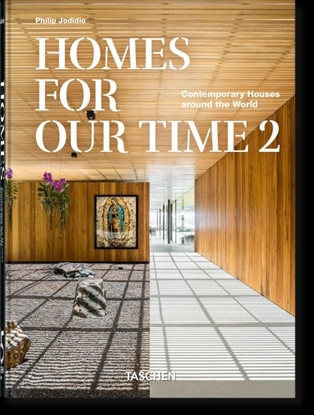
Homes For Our Time. Contemporary Houses around the World. Vol. 2. 45th Ed.
Climate, environment, history, and technology are transforming architecture worldwide. The second volume in the Homes for Our Time series documents this housing revolution and raises questions: What role do homes play in our endangered world? How can they innovate?
In Sri Lanka, Palinda Kannangara created the Frame Holiday Structure on a budget of $ 40,000. Built from steel scaffolding, exposed brick, and wood floors, the house can be easily disassembled and moved, adapting to the reality of the nearby floodplain. Luciano Lerner Basso’s Fortunata House in Brazil accommodates the surrounding nature: it was built around a tree of an endangered species and sits upon stilts so as not to disturb the forest floor. Miller Hull’s Loom House near Seattle has been called “the world’s most environmentally ambitious home renovation” because of its reliance on recycled materials and its efficient energy use.
Modern architectural history has been viewed primarily from a Western perspective and formed by men. More than 60 buildings from Vietnam, South Africa, India, China, and beyond—designed by men, women, and collectives—mark the end of this era. There is no longer a predominant style, and there probably never will be again. With photos by renowned architectural photographers, and precise descriptions as well as drawings from architectural offices, Philip Jodidio charts the diverse, sustainable architecture of the future. The private homes featured range from modest to extravagant. A beautiful house is always also a dream—and this book invites you to do just that.
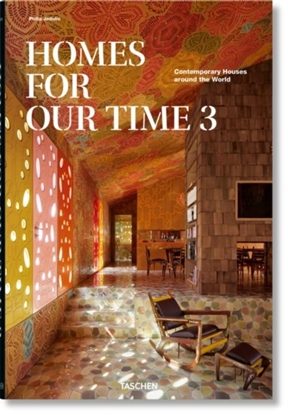
Homes for Our Time. Contemporary Houses around the World. Vol. 3
Peeking behind the scenes of innovative homes, Philip Jodidio illustrates the evolution of today’s global architecture—from Samira Rathod’s House of Concrete Experiments in India to Tetro’s Açucena House in Brazil, which adapts to its natural terrain.
The houses featured in this book may be the first full generation to take advantage of the ubiquity of computing power—from design to fabrication—yet this high-tech approach has in no way diminished their variety and originality. In Italy, Mario Cucinella built TECLA – Technology and Clay, a 3D-printed house created entirely with raw earth. The unique house, printed in 200 hours with 60 cubic meters of natural materials, unveils potential low-cost, environmentally responsible approaches to architecture. In Hyderabad, India, Kanan Modi designed her House of Gardens not only to diffuse and reduce heat within the structure but also to invite the beauty of nature indoors—both essential in the face of rising temperatures and increasing urbanization.
These forward-thinking buildings were designed by capitalizing on technological advances such as video conferencing and 3D printing, fostering inventiveness and imagination, and yielding sustainable, site-specific homes. Atelier Bow-Wow virtually directed the construction of their Peninsula House on the Greek island of Antiporos during the COVID-19 pandemic; Mariko Mori’s Yuputira unifies her artistic and architectural aesthetics; and Anne Fougeron’s Suspension House breathes new life into a remarkable natural setting.
Detailing 59 cutting-edge projects from 25 countries—ranging from Guatemala and Slovenia to Norway and Vietnam—the third volume of the Homes for Our Time series takes readers on an illustrated visit of contemporary architectural gems, discovering the architects who are driving change in the field now, and in the future. These homes are the beating heart of creativity that will inspire architecture for decades to come.
Homeschooling in Nederland
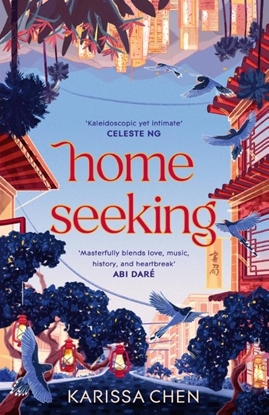
Homeseeking
'Deeply moving'
Abi Daré
'Weaves expertly between present and past'
Celeste Ng
'Unforgettable'
Washington Post
'Mesmerising'
Harper's Bazaar
Suchi first sees Haiwen in their Shanghai neighbourhood when she is seven years old, drawn by the sound of his violin. Their childhood friendship blossoms into love, but when Haiwen secretly enlists in the Nationalist army in 1947 to save his brother from the draft, Suchi is left with just his violin and a note: Forgive Me.
Sixty years later, recently widowed Haiwen spots Suchi at a grocery store in Los Angeles. It feels to Haiwen like a second chance, but Suchi has only survived by refusing to look back. In the twilight of their lives, can they reclaim their past and the love they lost?
Homeseeking follows the separated lovers through six decades of tumultuous Chinese history, telling Haiwen's story from the present to the past while tracing Suchi's from her childhood to the present, meeting at the crucible of their lives. From Shanghai to Hong Kong, Taiwan, and the United States, neither loses sight of the home they hold in their hearts.
'A love story in more ways than one'
Vanessa Chan
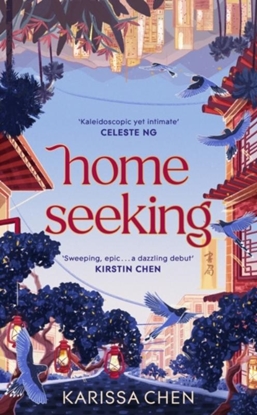
Homeseeking
A GOOD MORNING AMERICA BOOK CLUB PICK
'A layered, beautifully written, and deeply moving novel. Karissa Chen masterfully blends love, music, history, and heartbreak to create a sweeping tale that spans decades and continents'
Abi Daré
'[Homeseeking] weaves expertly between present and past, telling the story of childhood sweethearts who meet again late in life and are torn between looking back and moving on'
Celeste Ng
'Wonderfully cinematic, gorgeously orchestrated . . . like any tried-and-true epic (think Pachinko or The Joy Luck Club) . . . Homeseeking is just a genuine pleasure to read'
San Francisco Chronicle
'As I tearfully turned the last page of Homeseeking, I knew that it had earned a place on my top shelf . . . unforgettable'
Washington Post
There are moments when a single choice can define an entire life. Haiwen and Suchi are teenage sweethearts in 1940s Shanghai; their childhood friendship has blossomed into young love, and they believe that they are soulmates. But when Haiwen secretly decides to enlist in the army to keep his brother from the draft, their shared future is shattered. Their paths take them far afield from each other, with the exception of one pivotal chance encounter on the Hong Kong ferry in 1966.
Sixty years later, Haiwen, now in his late seventies, is bagging bananas at a 99 Ranch in Los Angeles when he lifts his head to once more see Suchi. As they begin to rekindle their friendship, it feels like they might have a second chance to live the life they were supposed to have together. But the weight of the past lives with them at every moment, and only time will tell if they are able to forge something new.
Told in alternating narratives, Homeseeking spans seven decades, through the most tumultuous period of modern Chinese history up to contemporary times, tracing the separated lovers as they migrate from Shanghai to Hong Kong, Taiwan, and America.
'A love story in more ways than one, Homeseeking is a beautiful, nuanced look at Chinese history, family, young love, and the wisdom of age'
Vanessa Chan Lees meer

Homesick