
Algemene economie
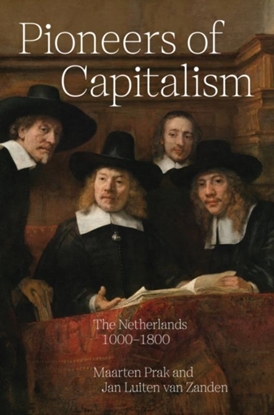
Pioneers of Capitalism
How medieval Dutch society laid the foundations for modern capitalism
The Netherlands was one of the pioneers of capitalism in the Middle Ages, giving rise to the spectacular Dutch Golden Age while ushering in an era of unprecedented, long-term economic growth. Pioneers of Capitalism examines the formal and informal institutions in the Netherlands that made this economic miracle possible, providing a groundbreaking new history of the emergence and early development of capitalism.
Drawing on the latest quantitative theories in economic research, Maarten Prak and Jan Luiten van Zanden show how Dutch cities, corporations, guilds, commons, and other private and semipublic organizations provided safeguards for market transactions in the state’s absence. Informal institutions developed in the Netherlands long before the state created public safeguards for economic activity. Prak and van Zanden argue that, in the Netherlands itself, capitalism emerged within a robust civil society that constrained and counterbalanced its centrifugal forces, but that an unrestrained capitalism ruled in the overseas territories. Rather than collapsing under unrestricted greed, the Dutch economy flourished, but prosperity at home came at the price of slavery and other dire consequences for people outside Europe.
Pioneers of Capitalism offers a panoramic account of the early history of capitalism, revealing how a small region of medieval Europe transformed itself into a powerhouse of sustained economic growth, and changed the world in the process.

Porcelain
"This is the book on porcelain we have been waiting for. . . . A remarkable achievement."—Edmund de Waal, author of The Hare with Amber Eyes
A sweeping cultural and economic history of porcelain, from the eighteenth century to the present
Porcelain was invented in medieval China—but its secret recipe was first reproduced in Europe by an alchemist in the employ of the Saxon king Augustus the Strong. Saxony’s revered Meissen factory could not keep porcelain’s ingredients secret for long, however, and scores of Holy Roman princes quickly founded their own mercantile manufactories, soon to be rivaled by private entrepreneurs, eager to make not art but profits. As porcelain’s uses multiplied and its price plummeted, it lost much of its identity as aristocratic ornament, instead taking on a vast number of banal, yet even more culturally significant, roles. By the nineteenth and twentieth centuries, it became essential to bourgeois dining, and also acquired new functions in insulator tubes, shell casings, and teeth.
Weaving together the experiences of entrepreneurs and artisans, state bureaucrats and female consumers, chemists and peddlers, Porcelain traces the remarkable story of “white gold” from its origins as a princely luxury item to its fate in Germany’s cataclysmic twentieth century. For three hundred years, porcelain firms have come and gone, but the industry itself, at least until very recently, has endured. After Augustus, porcelain became a quintessentially German commodity, integral to provincial pride, artisanal industrial production, and a familial sense of home.
Telling the story of porcelain’s transformation from coveted luxury to household necessity and flea market staple, Porcelain offers a fascinating alternative history of art, business, taste, and consumption in Central Europe.

Power and Progress
WINNERS OF THE 2024 NOBEL PRIZE FOR ECONOMICS
LONGLISTED FOR THE BAILLIE GIFFORD PRIZE
LONGLISTED FOR THE FINANCIAL TIMES AND SCHRODERS BUSINESS BOOK OF THE YEAR
SHORTLISTED FOR THE LIONEL GELBER PRIZE
A FINANCIAL TIMES TECHNOLOGY BOOK OF THE YEAR
UPDATED WITH A NEW PREFACE
'The blueprint we need for the challenges ahead' Shoshana Zuboff
'If you are not already an addict of Daron Acemoglu and Simon Johnson's previous books, Power and Progress is guaranteed to make you one' Jared Diamond
'A breathtaking tour of the history and future of technology' Abhijit Banerjee and Esther Duflo
A bold new interpretation of why technology benefits the elites - and how we must reshape the path of innovation to create true shared prosperity.
A thousand years of history make one thing clear: progress is not automatic but depends on the choices we make. Much of the wealth generated by agricultural advances during the Middle Ages was captured by the Church while the peasants starved. The first hundred years of industrialization delivered stagnant incomes for workers, while making a few people rich. Throughout the world today, digital technologies and artificial intelligence increase inequality and undermine democracy. It doesn't have to be this way.
Power and Progress demonstrates that the path of technology was once - and can again be - brought under control. With their breakthrough economic theory and manifesto for a better society, Acemoglu and Johnson provide the vision to reshape how we innovate so we can create real prosperity for all.
Daron Acemoglu and Simon Johnson were awarded the Nobel Prize in Economic Sciences on 14 October 2024.
Lees meer



Standard Deviations


