
Culturele antropologie algemeen


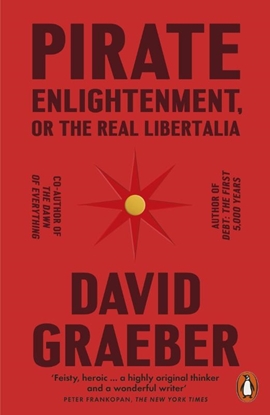
Pirate Enlightenment, or the Real Libertalia
'A characteristically radical re-reading of history that places the social and political experiments of pirates at the heart of the European Enlightenment. A brilliant companion volume to the best-selling Dawn of Everything' Amitav Ghosh
The Enlightenment did not begin in Europe. Its true origins lie thousands of miles away on the island of Madagascar, in the late seventeenth century, when it was home to several thousand pirates. This was the Golden Age of Piracy - but it was also, argues anthropologist David Graeber, a brief window of radical democracy, as the pirate settlers attempted to apply the egalitarian principles of their ships to a new society on land.
In this jewel of a book, Graeber offers a way to 'decolonize the Enlightenment', demonstrating how this mixed community experimented with an alternative vision of human freedom, far from that being formulated in the salons and coffee houses of Europe. Its actors were Malagasy women, philosopher kings and escaped slaves, exploring ideas that were ultimately to be put into practice by Western revolutionary regimes a century later.
Pirate Enlightenment playfully dismantles the central myths of the Enlightenment. In their place comes a story about the magic, sea battles, purloined princesses, manhunts, make-believe kingdoms, fraudulent ambassadors, spies, jewel thieves, poisoners and devil worship that lie at the origins of modern freedom.


SHHHHHHROOM Amanita Muscaria

Textures of Power
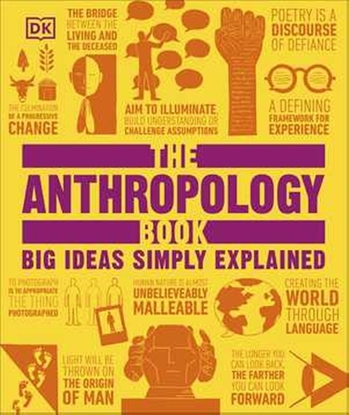
The Anthropology Book
Explore and understand the key ideas and movements in anthropology – the study of human societies and cultures and how they work.
What does it mean to be human? Why do we have rituals? How do family structures differ around the world, and why? The Anthropology Book answers questions like these and many, many more. Applying the “Big Ideas” series’ combination of authoritative, accessible text and bold graphics, The Anthropology Book introduces key concepts from different branches of the subject, such as cultural anthropology, ethnography, and biological anthropology, and explains how they have developed over the past century. The book explores the origins of human life and cultures, and how societies develop traditions, laws, and languages. Profiling renowned anthropologists, such as Claude Lévi-Strauss and Margaret Mead, and covering topics as diverse as biology, medicine, war, sexuality, family roles, and kinship, The Anthropology Book is a fascinating, accessible introduction to the core principles of anthropological thought.
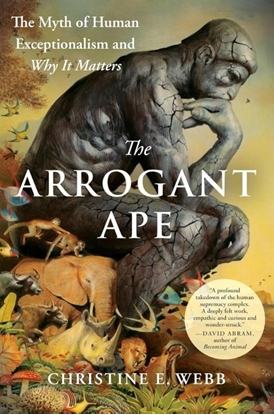
The Arrogant Ape
Darwin considered humans one part of the web of life, not the apex of a natural hierarchy. Yet today many maintain that we are the most intelligent, virtuous, successful species that ever lived. This flawed thinking enables us to exploit the earth towards our own exclusive ends, throwing us into a perilous planetary imbalance. But is this view and way of life inevitable? The Arrogant Ape shows that human exceptionalism is an ideology that relies more on human culture than our biology, more on delusion and faith than on evidence.
Harvard primatologist Christine Webb has spent years researching the rich social, emotional, and cognitive lives of our closest living relatives. She exposes the ways that many scientific studies are biased against other species and reveals underappreciated complexities of nonhuman life—from the language of songbirds and prairie dogs, to the cultures of chimpanzees and reef fishes, to the acumen of plants and fungi. With compelling stories and fresh research she gives us a paradigm-shifting way of looking at other organisms on their own terms, one that is revolutionizing our perception both of them and of ourselves.
Critiques of human exceptionalism tend to focus on our moral obligation towards other species. They overlook what humanity also stands to gain by dismantling its illusions of uniqueness and superiority. This shift in perspective fills us with a sense of awe and satisfies one of our oldest and deepest desires to belong to the larger whole we inhabit. What’s at stake is a better, sustainable way of life with the potential to heal and rejuvenate our shared planet. Lees meer

The Dawn of Everything
THE NEW YORK TIMES BESTSELLER AND SUNDAY TIMES, OBSERVER AND BBC HISTORY BOOK OF THE YEAR
FINALIST FOR THE ORWELL PRIZE FOR POLITICAL WRITING 2022
'Pacey and potentially revolutionary' Sunday Times
'Iconoclastic and irreverent ... an exhilarating read' The Guardian
For generations, our remote ancestors have been cast as primitive and childlike - either free and equal, or thuggish and warlike. Civilization, we are told, could be achieved only by sacrificing those original freedoms or, alternatively, by taming our baser instincts. David Graeber and David Wengrow show how such theories first emerged in the eighteenth century as a reaction to indigenous critiques of European society, and why they are wrong. In doing so, they overturn our view of human history, including the origins of farming, property, cities, democracy, slavery and civilization itself.
Drawing on path-breaking research in archaeology and anthropology, the authors show how history becomes a far more interesting place once we begin to see what's really there. If humans did not spend 95 per cent of their evolutionary past in tiny bands of hunter-gatherers, what were they doing all that time? If agriculture, and cities, did not mean a plunge into hierarchy and domination, then what kinds of social and economic organization did they lead to? The answers are often unexpected, and suggest that the course of history may be less set in stone, and more full of playful possibilities than we tend to assume.
The Dawn of Everything fundamentally transforms our understanding of the human past and offers a path toward imagining new forms of freedom, new ways of organizing society. This is a monumental book of formidable intellectual range, animated by curiosity, moral vision and faith in the power of direct action.
'This is not a book. This is an intellectual feast' Nassim Nicholas Taleb
'The most profound and exciting book I've read in thirty years' Robin D. G. Kelley


The Museum of Other People
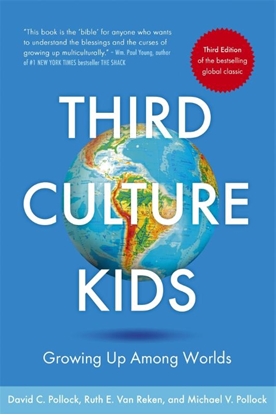
Third Culture Kids
'This book is the 'bible' for anyone who wants to understand the blessings and the curses of growing up multiculturally' -Wm. Paul Young, author of the #1 New York Times bestseller The Shack
In this third edition of the ground-breaking, global classic, Ruth E. Van Reken and Michael V. Pollock, son of the late original co-author, David C. Pollock have significantly updated what is widely recognized as The TCK Bible. Emphasis is on the modern TCK and addressing the impact of technology, cultural complexity, diversity & inclusion and transitions. Includes new advice for parents and others for how to support TCKs as they navigate work, relationships, social settings and their own personal development.
Specific updates:
· A second PolVan Cultural Identity diagram to support understanding of cultural identity
· New models for identity formation
· Updated explanation of unresolved grief
· New material on 'highly mobile communities' addressing the needs of people who stay put while a community around them moves rapidly
· Revamped Section III so readers can more easily find what is relevant to them as Adult TCKs, parents, counselors, employers, spouses, administrators, etc.
· New stages and needs tool that will help families and organizations identify and meet needs
· Greater emphasis on tools for educators as they grapple with demographic shifts in the classroom

