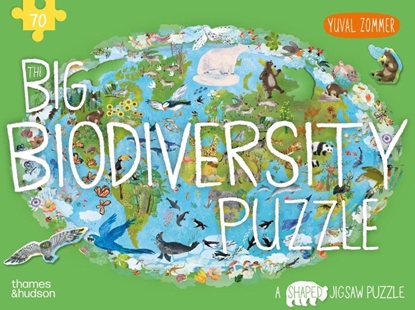
How many species of animals, bugs, and plants can you name on land and in the ocean? Discover the huge variety of living things through this Earth-shaped puzzle and learn about the unique roles they play in their environment.
Illustrated by bestselling author and illustrator Yuval Zommer, The Big Biodiversity Puzzle is an introduction to biodiversity with over forty creatures and is filled with fascinating facts. Did you know that the Amazon rainforest is home to over 3 million types of plants and animals? And that monarch butterflies fly all the way from Canada to Mexico every year to escape the winter cold? Or that elephant footprints create homes for tadpoles?
Learn about animals, environments, and geography as you piece Earth together. This 70-piece puzzle includes eight shaped pieces and a fact-filled poster.
Why do interiors of houses mimic nature – the wallpapers and curtains, flowers in vases, a vaporizer in the bathroom? Why do we so often connect our childhoods with gardens? Why has the myth of a lost Eden been so ubiquitous and so formative?The Green Fuse: Essays in Making Sense of Gardens explores our deep-rooted impulses to create gardens, examining them through the lenses of history, religion, nostalgia and myth. It connects gardens with the other arts – painting, music, literature and theatre – and contemplates their intellectual and philosophical significance. Blending lyrical reflections with research, it offers an unusually wide-ranging and thoughtful perspective on gardens and why we make them. It will be ideal for all readers interested in gardening and its cultural implications. Lees meer
The Year takes us on a journey exploring how nature transforms across twelve months, each chapter focusing on a specific month’s natural events, from spring’s beginning through to winter’s end. It opens with an overview of our evolving understanding of time and nature, from ancient astronomy to the present, and concludes with a chapter on the impact of climate change. Spike Bucklow draws on both modern ecological studies and historical naturalists such as Aristotle, Gilbert White, Thoreau and Aldo Leopold. Poetic reflections from Ovid, Shakespeare, John Clare and William Wordsworth enrich the narrative, giving further insights into nature’s changes. Blending modern science with traditional wisdom, The Year provides a positive perspective on ecological, global and personal change, appealing to those interested in ecology, astrology and the history of science. Lees meer