Natuurkunde algemeen












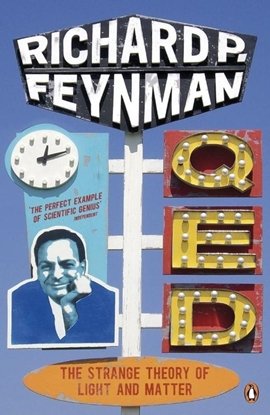
Qed
In QED: The Strange Theory of Light and Matter Richard P. Feynman explains, in his lucid and witty style, the revolutionary scientific theory that won him the Nobel Prize.
Quantum electrodynamics - or QED for short - is the theory that explains how light and electrons interact, and in doing so illuminates the deepest and most complex mysteries of the world around us.
Thanks to Richard Feynman and his colleagues, who won the Nobel Prize for their groundbreaking work in this area, it is also one of the rare parts of physics that is known for sure - a theory that has stood the test of time. In these entertaining lectures Feynman uses clear everyday examples to provide the definitive introduction to QED.
'The perfect example of scientific genius'
Independent
'If you don't believe Nature is absurd, let chatty Professor Feynman convince you in his series of exceedingly reader-friendly lectures ... Full of witty one-liners, with its learning lightly worn, it's a book to enlighten'
Mail on Sunday
'Does a marvelous job of explaining one of twentieth-century physics' few unqualified triumphs'
The New York Times
Richard P. Feynman (1918-1988) was one of this century's most brilliant theoretical physicists and original thinkers. Feynman's other books, also available in Penguin, include QED, Six Easy Pieces, Six Not-so-Easy Pieces, Don't You Have Time to Think, The Pleasure of Finding Things Out, What Do You Care What Other People Think? and The Meaning of it All.
Lees meer
Quantum
From Schrodinger's cat to Heisenberg's uncertainty principle, this book untangles the weirdness of the quantum world.
'A master of making the complex simple' Independent
'Al-Khalili is the ideal guide through [the] mysteries of modern science' New Scientist
'Superb' Guardian
Quantum mechanics underpins modern science and provide us with a blueprint for reality itself. And yet it has been said that if you're not shocked by it, you don't understand it. But is quantum physics really so unknowable? Is reality really so strange? And just how can cats be half-alive and half-dead at the same time?
Our journey into the quantum begins with nature's own conjuring trick, in which we discover that atoms - contrary to the rules of everyday experience - can exist in two locations at once. To understand this, we travel back to the dawn of the twentieth century and witness the birth of quantum theory, which over the next one hundred years was to overthrow so many of our deeply held notions about the nature of our universe. Scientists and philosophers have been left grappling with its implications ever since.
'An excellent and lavishly illustrated book' Marcus Chown, New Scientist
'This guide may leave the reader enlightened and perplexed at the same time. Reassuringly, the pros feel the same' Independent
Readers love this:
'It's clear and straightforward . . . I think I may have finally understood what the quantum universe is about. If I have it's because the book is well written' ⭐⭐⭐⭐⭐
'I took Quantum Mechanics as part of my physics degree in 1967 and didn't understand a word of it. Where were you Jim when I needed you most!' ⭐⭐⭐⭐⭐
'The inexplicable presented in a very readable way' ⭐⭐⭐⭐⭐
'I must say Jim Al-Khalili has got to be . . . the funniest scientist on the planet' ⭐⭐⭐⭐⭐
'Quantum Mechanics demonstrates that fact is stranger than fiction' ⭐⭐⭐⭐⭐
Lees meer