
Oorlog en vrede
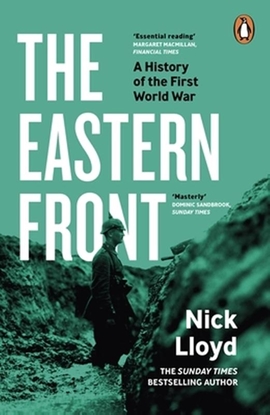
The Eastern Front
'The First World War from a refreshingly unfamiliar angle . . . masterly' Dominic Sandbrook, Sunday Times
'Compelling . . . The Eastern Front is essential reading' Margaret Macmillan, Financial Times
‘A masterwork . . . This is the history of the Eastern Front I’ve waited all my life to read’ Simon Sebag Montefiore
The definitive history of the Eastern Front in the First World War, from the acclaimed military historian and author of Passchendaele and The Western Front
***********
In the second volume of his landmark First World War trilogy, Professor Nick Lloyd tells the story for the first time of what Winston Churchill once called the 'unknown war': the vast conflict in Eastern Europe and the Balkans that brought about the collapse of three empires.
Much has been written about the fighting in France and Belgium, yet the Eastern Front was no less bloody. Between 1914 and 1917, huge numbers of people - perhaps as many as 16 million soldiers and two million civilians - were killed, wounded or maimed in enormous battles that sometimes ranged across a front of 100 km in length. Through intimate eyewitness reports, diary entries and memoirs - many of which have never been translated into English before - Lloyd reconstructs the full story of a war that began in the Balkans as a local struggle between Austria-Hungary and Serbia, and which sucked in Russia, Germany and Italy, right through to the final collapse of the Habsburg Empire in 1918.
The Eastern Front paints a vivid and authoritative picture of a conflict that shook the world, and that remains central to understanding the tragic, blood-soaked trajectory of the twentieth century, and the current war in Ukraine.
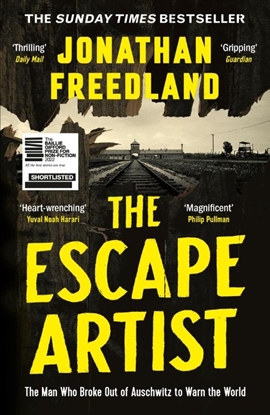
The Escape Artist


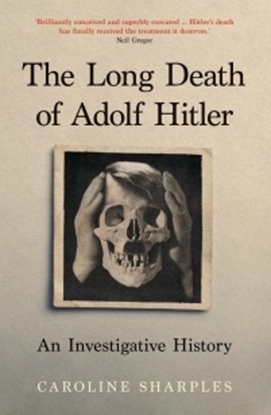
The Long Death of Adolf Hitler


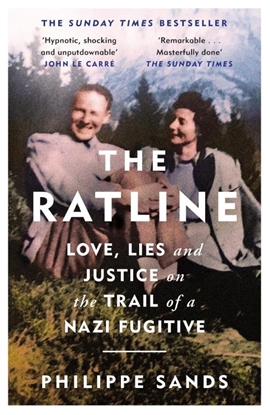
The Ratline
THE SUNDAY TIMES BESTSELLER FROM THE WINNER OF THE BAILLIE GIFFORD PRIZE
'Hypnotic, shocking and unputdownable' JOHN LE CARRÉ
'Remarkable' THE SUNDAY TIMES
'Breathtaking, gripping, shattering' ELIF SHAFAK
'A taut and finely crafted factual thriller' OBSERVER
'A triumph of research and brilliant storytelling' ANTONY BEEVOR
'Extraordinary' EVENING STANDARD
In this riveting real-life thriller, Philippe Sands offers a unique account of the daily life of senior Nazi SS Brigadeführer Otto Freiherr von Wächter and his wife, Charlotte. Drawing on a remarkable archive of family letters and diaries, he unveils a fascinating insight into life before and during the war, as a fugitive on the run in the Alps and then in Rome, and into the Cold War. Eventually the door is unlocked to a mystery that haunts Wächter's youngest son, who continues to believe his father was a good man - what happened to Otto Wächter while he was preparing to travel to Argentina on the 'ratline', assisted by a Vatican bishop, and what was the explanation for his sudden and unexpected death?
Lees meer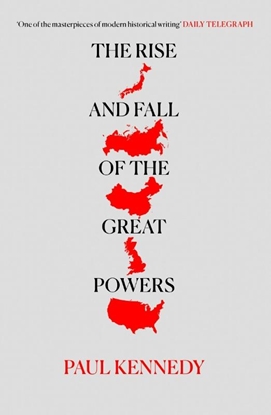
The Rise and Fall of the Great Powers
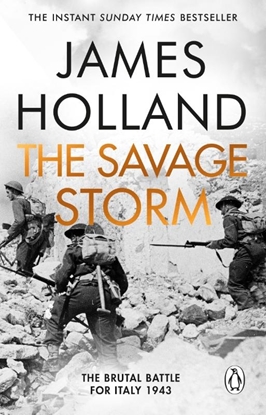
The Savage Storm
'Richly impressive, hard to surpass' William Boyd
'A notable account of an epic human experience' Max Hastings
‘James Holland brings every inch of this battle vividly to life’ History Revealed
‘This excellent book…The Savage Storm reinforces Holland’s reputation as certainly the busiest and probably the most popular military historian of the second world war working today’ Spectator
‘A must for anyone wanting to better understand the brutal campaign… thoroughly deserves a place on the bookshelf’ Soldier Magazine
_____________________
From the bestselling author of Brothers in Arms comes the story of the most pivotal Allies campaign of World War II.
With the invasion of France the following year taking shape, and hot on the heels of victory in Sicily, the Allies crossed into Southern Italy in September 1943. They expected to drive the Axis forces north and be in Rome by Christmas. And although Italy surrendered, the German forces resisted fiercely and the swift hoped-for victory descended into one of the most brutal battles of the war.
Even though shipping and materiel were already being safeguarded for the D-Day landings, there were still huge expectations on the progress of the invading armies, but those shortages were to slow the advance with tragic consequences. As the weather closed in, the critical weeks leading up to Monte Cassino would inflict a heavy price for every bloody, hard fought mile the Allied troops covered.
Chronicling those dark, dramatic months in unflinching and insightful detail, The Savage Storm is unlike any campaign history yet written. James Holland has always recounted the Second World War at ground level, but this version telling brings the story vividly to life like never before. Weaving together a wealth of letters, diaries, and other incredible documents, Holland traces the battles as they were fought - across plains, over mountains, through shattered villages and cities, in intense heat and, towards the end, frigid cold and relentless rain - putting readers at the heart of the action to create an entirely fresh and revealing telling of this most pivotal phase of the war.
_____________________
Praise for James Holland
'Impeccably researched and superbly written' Observer
'Holland has something new to say.... Filled with insight and detail' Neil Oliver
'James Holland is the best of the new generation of WW2 historians' Sebastian Faulks
'[A] captivating and dramatic account. . . Drawn from letters and diaries, Holland’s immersive narrative is told through the eye-level perspectives... Readers will be enthralled' Publishers Weekly
‘A remarkable achievement by a historian at the height of his powers. Holland has successfully illustrated both the significance and the savagery of the Italian campaign... through a powerful and compelling narrative’ Military History Matters

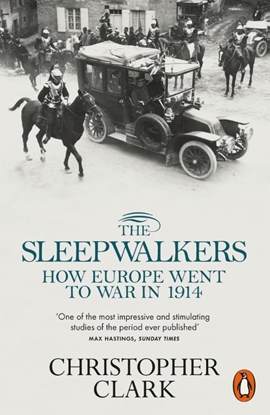
The Sleepwalkers
The pacy, sensitive and formidably argued history of the causes of the First World War, from acclaimed historian and author Christopher Clark
FINANCIAL TIMES BOOKS OF THE YEAR 2014
SUNDAY TIMES and INDEPENDENT BOOKS OF THE YEAR 2012
Winner of the Los Angeles Times History Book Prize 2014
The moments that it took Gavrilo Princip to step forward to the stalled car and shoot dead Franz Ferdinand and his wife were perhaps the most fateful of the modern era. An act of terrorism of staggering efficiency, it fulfilled its every aim: it would liberate Bosnia from Habsburg rule and it created a powerful new Serbia, but it also brought down four great empires, killed millions of men and destroyed a civilization. What made a seemingly prosperous and complacent Europe so vulnerable to the impact of this assassination?
In The Sleepwalkers Christopher Clark retells the story of the outbreak of the First World War and its causes. Above all, it shows how the failure to understand the seriousness of the chaotic, near genocidal fighting in the Balkans would drag Europe into catastrophe.
Reviews:
'Formidable ... one of the most impressive and stimulating studies of the period ever published' Max Hastings, Sunday Times
'Easily the best book ever written on the subject ... A work of rare beauty that combines meticulous research with sensitive analysis and elegant prose. The enormous weight of its quality inspires amazement and awe ... Academics should take note: Good history can still be a good story' Washington Post
'A lovingly researched work of the highest scholarship. It is hard to believe we will ever see a better narrative of what was perhaps the biggest collective blunder in the history of international relations' Niall Ferguson
'[Reading The Sleepwalkers], it is as if a light had been turned on a half-darkened stage of shadowy characters cursing among themselves without reason ... [Clark] demolishes the standard view ... The brilliance of Clark's far-reaching history is that we are able to discern how the past was genuinely prologue ... In conception, steely scholarship and piercing insights, his book is a masterpiece' Harold Evans, New York Times Book Review
'Impeccably researched, provocatively argued and elegantly written ... a model of scholarship' Sunday Times Books of the Year
'Superb ... effectively consigns the old historical consensus to the bin ... It's not often that one has the privilege of reading a book that reforges our understanding of one of the seminal events of world history' Mail Online
'A monumental new volume ... Revelatory, even revolutionary ... Clark has done a masterful job explaining the inexplicable' Boston Globe
'Superb ... One of the great mysteries of history is how Europe's great powers could have stumbled into World War I ... This is the single best book I have read on this important topic' Fareed Zakaria
'A meticulously researched, superbly organized, and handsomely written account' Military History
'Clark is a masterly historian ... His account vividly reconstructs key decision points while deftly sketching the context driving them ... A magisterial work' Wall Street Journal
'This compelling examination of the causes of World War I deserves to become the new standard one-volume account of that contentious subject' Foreign Affairs
'A brilliant contribution' Times Higher Education
'Clark is fully alive to the challenges of the subject ... He provides vivid portraits of leading figures ... [He] also gives a rich sense of what contemporaries believed was at stake in the crises leading up to the war' Irish Times
'In recent decades, many analysts had tended to put most blame for the disaster [of the First World War] on Germany. Clark strongly renews an older interpretation which sees the statesmen of many countries as blundering blindly together into war' Stephen Howe, Independent Books of the Year
About the author:
Christopher Clark is Professor of Modern History at the University of Cambridge and a Fellow of St Catharine's College. He is the author of The Politics of Conversion, Kaiser Wilhelm II and Iron Kingdom. Widely praised around the world, Iron Kingdom became a major bestseller. He has been awarded the Officer's Cross of the Order of Merit of the Federal Republic of Germany.
