‘China Under Xi Jinping: A New Assessment’ is one of the first scholarly books on Xi’s China during the Pandemic, which contains several features that are unmatched by existing scholarship. Lees meer
"The epic story of how America turned the world economy into a weapon, upending decades of globalization to take on a new authoritarian axis-Russia, China, and Iran. It used to be that ravaging another country's economy required blockading its ports and laying siege to its cities. Now all it takes is a statement posted online by the U.S. government. In Chokepoints, Edward Fishman, a former top State Department sanctions official, takes us deep into the back rooms of power to reveal the untold history of the last two decades of U.S. foreign policy, in which America renounced the gospel of globalization and waged a new kind of economic war. As Vladimir Putin, Xi Jinping, and Ayatollah Khamenei wreaked havoc on the world stage, mavericks within the U.S. government built a fearsome new arsenal of economic weapons, exploiting America's dominance in global finance and technology. Successive U.S. presidents have relied on these unconventional weapons to address the most pressing national-security threats, for good and for ill. Chokepoints provides a thrilling account of one of the most critical geopolitical developments of our time, demystifying the complex strategies the U.S. government uses to harness the power of Wall Street, Silicon Valley, and Big Oil against America's enemies. At the center of the narrative is an eclectic group of policy innovators: the diplomats, lawyers, and financial whizzes who've masterminded America's escalating economic wars against Russia, China, and Iran. Economic warfare has become the primary way the United States confronts international crises and counters rivals. Sometimes it has achieved spectacular success; other times, bitter failure. The result we live with today is a new world order: an economic arms race among great powers and a fracturing global economy. Chokepoints is the definitive account of how America pioneered this new, hard-hitting style of economic war-and how it's changing the world"-- Lees meer
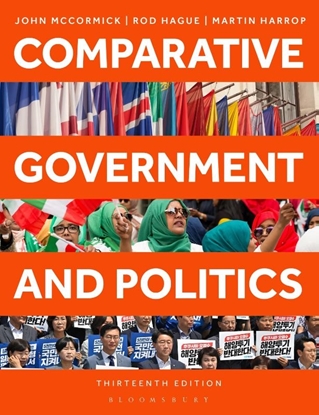
What are the markers of authoritarian and democratic states – and all those that fall somewhere in-between? How do principles, institutions and political processes differ from state to state? And what can we learn from political comparison on a global scale?
Comparative Government and Politics offers a compelling and accessible introduction to the subject. This book will help you to understand the wide range of institutions and political cultures across the world, including: the common essential elements and levers of a state, how democratic and authoritarian regimes operate internally and on the global stage, and the relationship between a population and a polity. An essential text for courses on Comparative Politics, Comparative Government, Introduction to Politics and Introduction to Political Science.
This Thirteenth Edition includes: · An increased focus on themes of democratic reversal and declining trust · Coverage of contemporary topics with new and extended coverage of LGBTQ+ issues, identity politics and populism · New and updated country spotlights, reflecting the changing state of democracy across the world · An accessible design for students of all levels, with maps, diagrams and tables, discussion questions and further reading suggestions · A companion website with features to support continued learning: bloomsbury.pub/comparative-government-and-politics-13e
A seminal figure in the field of public management, Mark H. Moore presents his summation of fifteen years of research, observation, and teaching about what public sector executives should do to improve the performance of public enterprises. Useful for both practicing public executives and those who teach them, this book explicates some of the richest of several hundred cases used at Harvard’s Kennedy School of Government and illuminates their broader lessons for government managers. Moore addresses four questions that have long bedeviled public administration: What should citizens and their representatives expect and demand from public executives? What sources can public managers consult to learn what is valuable for them to produce? How should public managers cope with inconsistent and fickle political mandates? How can public managers find room to innovate?Moore’s answers respond to the well-understood difficulties of managing public enterprises in modern society by recommending specific, concrete changes in the practices of individual public managers: how they envision what is valuable to produce, how they engage their political overseers, and how they deliver services and fulfill obligations to clients. Following Moore’s cases, we witness dilemmas faced by a cross-section of public managers: William Ruckelshaus and the Environmental Protection Agency; Jerome Miller and the Department of Youth Services; Miles Mahoney and the Park Plaza Redevelopment Project; David Sencer and the swine flu scare; Lee Brown and the Houston Police Department; Harry Spence and the Boston Housing Authority. Their work, together with Moore’s analysis, reveals how public managers can achieve their true goal of producing public value. Lees meer