Theoretische geschiedenis

Penguin Modern Classics Orientalism
The seminal work that has redefined our understanding of colonialism and empire, with a preface by the author
'Stimulating, elegant and pugnacious' Observer
'Magisterial' Terry Eagleton
In this highly-acclaimed work, Edward Said surveys the history and nature of Western attitudes towards the East, considering orientalism as a powerful European ideological creation - a way for writers, philosophers and colonial administrators to deal with the 'otherness' of eastern culture, customs and beliefs. He traces this view through the writings of Homer, Nerval and Flaubert, Disraeli and Kipling, whose imaginative depictions have greatly contributed to the West's romantic and exotic picture of the Orient. Drawing on his own experiences as an Arab Palestinian living in the West, Said examines how these ideas can be a reflection of European imperialism and racism.
'Beautifully patterned and passionately argued'
New Statesman
'Very exciting ... his case is not merely persuasive, but conclusive'
John Leonard, New York Times
Penguin Modern Classics The Rebel
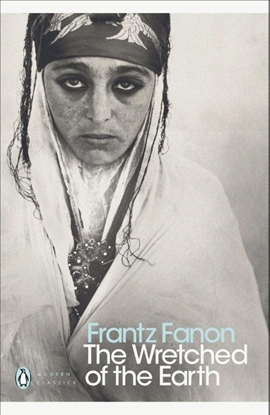
Penguin Modern Classics The Wretched of the Earth
'This century's most compelling theorist of racism and colonialism' Angela Davis
Written at the height of the Algerian war for independence from French colonial rule and first published in 1961, Frantz Fanon's Wretched of the Earth has provided inspiration for anti-colonial movements ever since, analysing the role of class, race, national culture and violence in the struggle for freedom. With power and anger, Fanon makes clear the economic and psychological degradation inflicted by imperialism. It was Fanon, himself a psychotherapist, who exposed the connection between colonial war and mental disease, who showed how the fight for freedom must be combined with building a national culture, and who showed the way ahead, through revolutionary violence, to socialism.
'In clear language, in words that can only have been written in the cool heat of rage, he showed us the internal theatre of racism' Deborah Levy
Lees meer
Penguin Modern Classics Women, Race & Class
Ranging from the age of slavery to contemporary injustices, this groundbreaking history of race, gender and class inequality by the radical political activist Angela Davis offers an alternative view of female struggles for liberation.
Tracing the intertwined histories of the abolitionist and women's suffrage movements, Davis examines the racism and class prejudice inherent in so much of white feminism, and in doing so brings to light new pioneering heroines, from field slaves to mill workers, who fought back and refused to accept the lives into which they were born.
'The power of her historical insights and the sweetness of her dream cannot be denied' The New York Times
Lees meer
Portable Magic
'A fascinating journey into our relationship with the physical book...I lost count of the times I exclaimed with delight when I read a nugget of information I hadn't encountered before' Val McDermid, The Times
Most of what we say about books is really about the words inside them: the rosy nostalgic glow for childhood reading, the lifetime companionship of a much-loved novel. But books are things as well as words, objects in our lives as well as worlds in our heads. And just as we crack their spines, loosen their leaves and write in their margins, so they disrupt and disorder us in turn. All books are, as Stephen King put it, 'a uniquely portable magic'. Here, Emma Smith shows us why.
Portable Magic unfurls an exciting and iconoclastic new story of the book in human hands, exploring when, why and how it acquired its particular hold over us. Gathering together a millennium's worth of pivotal encounters with volumes big and small, Smith reveals that, as much as their contents, it is books' physical form - their 'bookhood' - that lends them their distinctive and sometimes dangerous magic. From the Diamond Sutra to Jilly Cooper's Riders, to a book made of wrapped slices of cheese, this composite artisanal object has, for centuries, embodied and extended relationships between readers, nations, ideologies and cultures, in significant and unpredictable ways.
Exploring the unexpected and unseen consequences of our love affair with books, Portable Magic hails the rise of the mass-market paperback, and dismantles the myth that print began with Gutenberg; it reveals how our reading habits have been shaped by American soldiers, and proposes new definitions of a 'classic'-and even of the book itself. Ultimately, it illuminates the ways in which our relationship with the written word is more reciprocal - and more turbulent - than we tend to imagine.
Lees meer
Raiders, Rulers, and Traders
No animal is so entangled in human history as the horse. The thread starts in prehistory, with a slight, shy animal hunted for food. Domesticating the horse allowed early humans to settle the vast Eurasian steppe; later, their horses enabled new forms of warfare, encouraged long-distance trade routes and acquired cultural and religious significance. Over time, horses came to power empires in Iran, Afghanistan, China, India and Russia.
David Chaffetz tells the story of how the horse made rulers, raiders and traders interchangeable, providing a novel explanation for the turbulent history of the “Silk Road”, which might be better called the Horse Road. Drawing on recent research in fields including genetics and forensic archaeology, Chaffetz presents a lively history of the great horse empires that shaped civilisation.
Lees meer
Revolusi
*Shortlisted for the Baillie Gifford Prize 2024* *Shortlisted for the Cundill Prize*
A story of staggering scope and drama, Revolusi is the masterful and definitive account of the epic revolution that changed the course of the 20th century.
'Astounding . . . history at its best' Yuval Noah Harari
'Utterly compelling . . . astonishing' Financial Times
'Superb' Guardian
On a sunny morning in August 1945, a handful of tired people raised a homemade cotton flag and announced the birth of a new nation: Indonesia. For three and a half centuries, its people had been subject to Dutch colonial rule. It would take another four years of guerrilla warfare and resistance – the ‘Revolusi’ – to finally win their freedom, blazing a trail that would reshape the world.
Drawing on hundreds of interviews and eye-witness testimonies, David Van Reybrouck’s superbly woven narrative is alive with human detail at every turn, showing Indonesia’s struggle for independence to be one of the defining dramas of the twentieth century.
*A Financial Times, Evening Standard, History Today and Prospect Best Book of the Year*
‘A magnificent fusion of oral history, sparkling analysis and historical wisdom. Revolusi has it all: a masterpiece’ Sebastian Mallaby
‘Masterly . . . compelling . . . convincingly argues that Indonesia in itself represents a global crossroads, one of the most important in modern history’ Elizabeth Pisani, The Times
‘We learn something utterly fascinating on every single page’ Evening Standard, Books of the Year
‘The story of [Indonesia’s] formation is delivered in a manner that genuinely seems unsurpassable’ History Today, Books of the Year
‘Revolusi briskly ushers Indonesia onto the centre stage of modern history’ Pankaj Mishra
‘With rare narrative brilliance, Revolusi gives us a history at once vast and intimate, a history in colour’ Laksmi Pamuntjak
‘A magisterial and gripping account of events of urgent importance to us now’ Jason Burke
‘A wonderful and important book’ Peter Frankopan
‘Majestic and beautifully written’ Times Literary Supplement
‘Immensely readable’ Adam Hochschild, Atlantic
‘An electrifying narrative’ Tunku Varadarajan, Wall Street Journal
‘The definitive account of a neglected epoch’ Economist
‘Masterly’ J M Coetzee

Rome
This hefty photographic portrait of Rome brings together hundreds of photographs from the 1840s through to today to explore the extraordinary history, beauty, and art of this incomparable cultural capital.
From sepia and black and white to color, these outstanding images dating from the 1840s to the present day allow us — through the eyes of such photographers as Giacomo Caneva, Pompeo Molins, Giuseppe Primoli, Alfred Eisenstaedt, Carlo Bavagnoli, Henri Cartier-Bresson, Pasquale De Antonis, Peter Lindbergh, Slim Aarons, and William Klein — to discover Rome in its many compelling guises: as the center of the Roman Empire, as one of the cradles of the Renaissance, as a favorite destination for travelers and a rich patchwork of varied neighborhoods, as the seat of the Roman Catholic Church, a stage for politics, and as the perfect backdrop for film and fashion shoots.
Reaching back into illustrious archives, some of the book’s early images offer us a privileged Grand Tour glimpse of some of Rome’s most treasured landmarks, revealing the Colosseum, Roman Forum, and Spanish Steps almost void of crowds. Later pictures survey the city’s contrasts—from the luxurious homes and leisure activities of the privileged to street stalls and laundry lines in the working class districts of Trastevere and Testaccio. Some documentary-style shots show us the dark power of Mussolini, the city bedecked with his own iconography and imagery of strength, athleticism, and the fatherland.
As color photography comes in, the city transitions from a neo-realismo aesthetic to postwar recovery and hedonism: all the glamorous gowns, exotic celebrities, and Via Veneto café culture immortalized by Fellini. Many famous faces are here, including Louis Armstrong, Elizabeth Taylor, Audrey Hepburn, Marcello Mastroianni, Sophia Loren, Pier Paolo Pasolini, Anna Magnani, and Valentino.
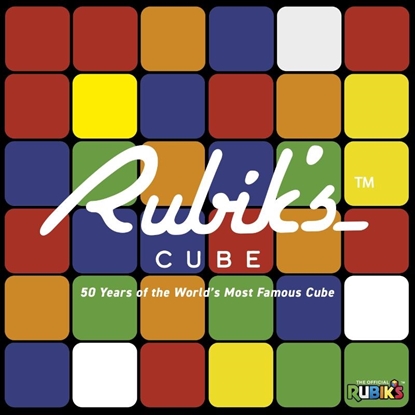
Rubik's
A vibrant visual celebration of the iconic cube.
The Rubik's® Cube was created in 1974 by ErnÅ‘ Rubik, a Hungarian architecture professor. Rubik later used the Cube as a learning exercise to teach his students about three-dimensional spaces. Little did he know his ';magic cube' (as he originally named it) would become one of the most famous puzzles of all time! By the 1980s, the Rubik's Cube was a worldwide craze, selling millions every year and cementing its pop culture legacy. It has featured in everything from The Simpsons to Harry Styles' last tour.
Perfect for all fans of the Cube, this book is a vibrant celebration of the iconic puzzle. It explores 50 key moments in the Cube's life, encompassing everything from its design evolution to celebrity solvers and cube-solving records. With great quotes, fascinating stats and facts, fun photos and plenty of nostalgia it is a perfect gift for the Rubik's fan in your life and offers plenty of new insight for seasoned solvers.
Includes a foreword by Ernő Rubik.
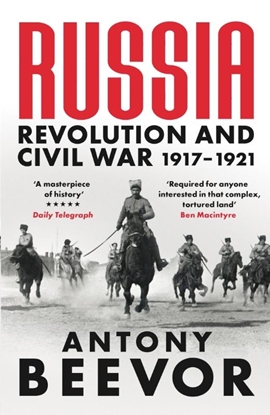
Russia
'A masterpiece of history'
DAILY TELEGRAPH
Between 1917 and 1921 a devastating struggle took place in Russia following the collapse of the Tsarist empire. Many regard this savage civil war as the most influential event of the modern era. An incompatible White alliance of moderate socialists and reactionary monarchists stood little chance against Trotsky's Red Army and Lenin's single-minded Communist dictatorship. Terror begat terror, which in turn led to even greater cruelty with man's inhumanity to man, woman and child. The struggle became a world war by proxy as Churchill deployed weaponry and troops from the British empire, while armed forces from the United States, France, Italy, Japan, Poland and Czechoslovakia played rival parts.
Using the most up to date scholarship and archival research, Antony Beevor, author of the acclaimed international bestseller Stalingrad, assembles the complete picture in a gripping narrative that conveys the conflict through the eyes of everyone from the worker on the streets of Petrograd to the cavalry officer on the battlefield and the woman doctor in an improvised hospital.
Lees meer
Silk Roads
Sparta
Sparta
Spice

Strangers and Intimates

Sunrise on the Reaping PB