Theoretische informatica
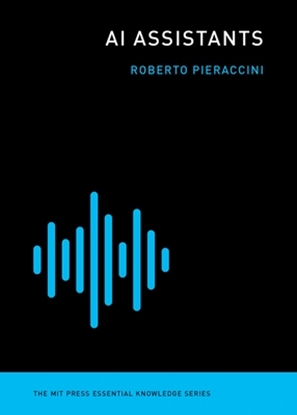
The MIT Press Essential Knowledge series AI Assistants
Have you talked to a machine lately? Asked Alexa to play a song, asked Siri to call a friend, asked Google Assistant to make a shopping list? This volume in the MIT Press Essential Knowledge series offers a nontechnical and accessible explanation of the technologies that enable these popular devices. Roberto Pieraccini, drawing on more than thirty years of experience at companies including Bell Labs, IBM, and Google, describes the developments in such fields as artificial intelligence, machine learning, speech recognition, and natural language understanding that allow us to outsource tasks to our ubiquitous virtual assistants.
Pieraccini describes the software components that enable spoken communication between humans and computers, and explains why it's so difficult to build machines that understand humans. He explains speech recognition technology; problems in extracting meaning from utterances in order to execute a request; language and speech generation; the dialog manager module; and interactions with social assistants and robots. Finally, he considers the next big challenge in the development of virtual assistants: building in more intelligence--enabling them to do more than communicate in natural language and endowing them with the capacity to know us better, predict our needs more accurately, and perform complex tasks with ease. Lees meer
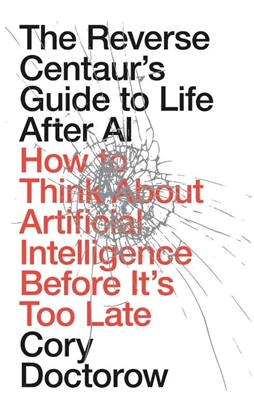
The Reverse Centaur's Guide to Life After AI
Don’t fall for the hype! The billionaires managing the rise of AI are putting on a command performance for the bosses and investors, not for the ordinary people who might use the products. When this latest tech bubble bursts, will there be something useful for us in the wreckage?
In The Reverse Centaur’s Guide to Life After AI, Doctorow examines why we find ourselves in this mess and how we can get out of it. Life after AI should mean the tools work for us, not the other way around. Lees meer

The Shortest History of AI
Since Alan Turing first posed the question “Can machines think?” artificial intelligence has evolved from a speculative idea to a transformative force. The Shortest History of AI traces this evolution, from Ada Lovelace’s visionary work to IBM’s groundbreaking defeat of the chess world champion and the revolutionary emergence of ChatGPT.
Revealing how many “overnight” successes were decades in the making, this accessible and illuminating book tells AI’s history through the six main ways it functions:
- It uses symbols to represent common concepts and ideas.
- It chooses its best possible move based on the information it is given.
- It simulates human expertise by following simple rules.
- It learns based on its past experiences.
- It assesses its mistakes and learns to avoid making them again in the future.
- It computes probability based on the evidence it’s provided with.
Fast-paced and rich with facts, The Shortest History of AI explores how artificial intelligence is being created—and how it will continue to transform and affect our lives now and in the future.
The Shortest History books deliver thousands of years of history in one riveting, fast-paced read.
Lees meer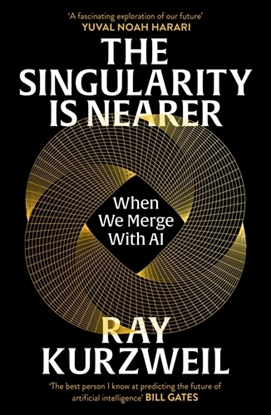
The Singularity is Nearer
In this visionary and fundamentally optimistic book, the legendary oracle of technological change explains how AI will transform our species beyond recognition.
‘The best person I know at predicting the future of AI’ BILL GATES
'A fascinating exploration of our future' YUVAL NOAH HARARI
'Essential reading to understand our exponential times' MUSTAFA SULEYMAN
Within our lifetimes, we will be able to connect our brains directly with AI, enhancing our intelligence a millionfold and expanding our consciousness in ways we can barely imagine. This is the Singularity. Ray Kurzweil is one of the greatest inventors of our time with over 60 years’ experience in the field of Artificial Intelligence. Dozens of his long-range predictions about the rise of the internet, AI and bioengineering have been borne out. Here Kurzweil explains how the Singularity will occur and what it will mean to live free from the limits of biology: What will we choose if our bodies need no longer define us? What new realms of beauty, connection and wonder might we inhabit? Who will we become if our minds can be stored and duplicated? Drawing on a lifetime’s expertise, Kurzweil presents deeply reasoned answers to these questions and argues that we can and will transform life on earth profoundly for the better.
Lees meer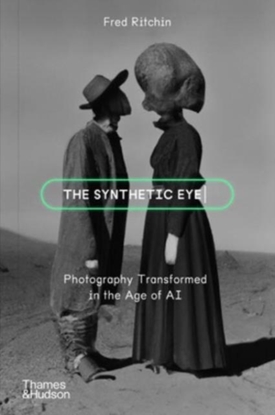
The Synthetic Eye
The revolution caused by artificial intelligence in terms of what a photograph can and cannot do is profound. This book looks at photography’s strengths, what it has meant for individuals and for society, its massive transformations caused by a variety of factors in the digital age, and the newer possibilities for image making. These include old and new media, with an emphasis on synthetic imaging as both a positive and terrifying development.
In 1840, a year after photography’s invention, the painter Paul Delaroche exclaimed, “From now on, painting is dead.” Photography was quicker and cheaper as a representational medium and more realistic, its invention also liberated painters to become much more adventurous, embracing approaches that included impressionism, cubism, minimalism, and abstract expressionism. So too photographers are being challenged today. Many have responded with new strategies, but more innovation is needed. Can photographers be as radically expansive and revolutionary as painters were? Can they preserve or even expand the photograph’s role in society as a credible witness? Can the photographic image morph into forms previously unimagined?
The Synthetic Eye is about this transformative revolution. How can synthetic imagery be utilized to amplify our understanding of ourselves and our worlds? Can an alternative photography deepen and expand the medium’s previous reach? What are the pitfalls? How will our senses of the real, the possible, and the actual be affected?
Lees meer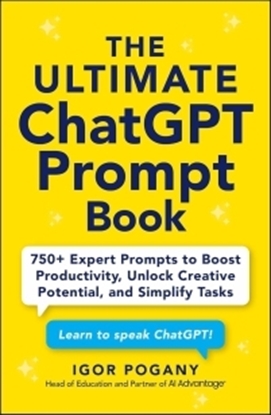
The Ultimate ChatGPT Prompt Book
In this indispensable guide, Igor Pogany, Head of Education and partner of AI Advantage, empowers both newcomers and seasoned experts alike to ';speak ChatGPT' with fluency and confidence.
Now, interacting with ChatGPT is easier than ever with more than 750 expert-tested prompts for a myriad of practical use-cases. 100+ ';cheat sheets' list specific prompts for achieving a given task, along with a prompting formula to help you tailor the prompt to your specific needs. Get equipped with ready-to-use solutions for your everyday challenges such as:
-Improving productivity when learning new skills
-Preparing schedules, balancing responsibilities, and creating budgets
-Crafting compelling narratives and brainstorming creative ideas
-Simplifying complex research topics
-Considering career viability, preparing for interviews, and crafting persuasive cover letters
-Prioritizing health with custom workout and meal plans
-Busting boredom with games, jokes, and new movies and music discovery
Unlock the immense potential of AI with The Ultimate ChatGPT Prompt Book and join the ranks of enthusiasts who have already revolutionized their lives with ChatGPT's versatility and ease of use. Lees meer
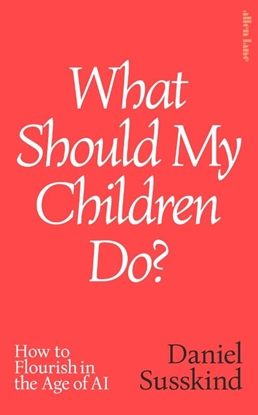
What Should My Children Do?
'As a call to action in the face of an unstoppable tide, Susskind's book is at once challenging, compelling and refreshingly optimistic' Guardian
From one of our leading experts on work and technology, a bold, clear-eyed, and hopeful guide to seizing opportunity in the age of AI
What should the next generation learn—and what should they stop worrying about—in a world transformed by artificial intelligence? AI is rewriting the rules in the classroom, the job market and the workplace, leaving parents, teachers, students and all types of workers unsure about how best to prepare for what lies ahead. In What Should My Children Do?, globally renowned economist Daniel Susskind cuts through the outdated advice to show us what young people actually need to succeed now.
We should not ban tools or discourage new skills that are in demand, Susskind argues, or cling to inherited ways of working. Instead, he reveals how people can master new technologies without eroding other essential skills. From reorganizing the curriculum to re-imagining white-collar careers, Susskind maps a smarter, more productive path forward.
This requires a fundamental mindset shift: we must embrace the extraordinary opportunities that AI brings—from personal tutors to scientific breakthroughs—rather than retreat from them. Drawing on fifteen years of research, this book is an evidence-based and practical guide to one of the most urgent questions of our time.
Lees meer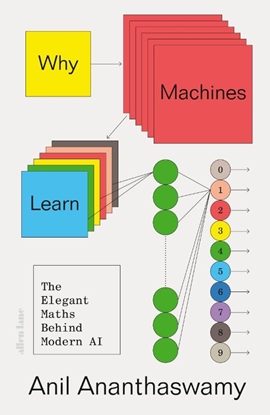
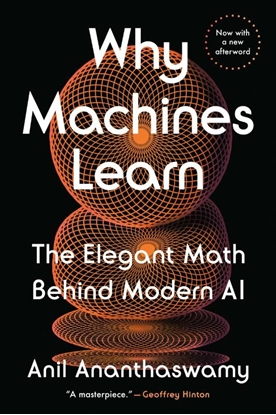
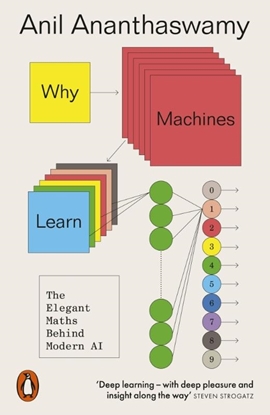
Why Machines Learn
'An invaluable companion for anyone who wants a deep understanding of what’s under the hood of often inscrutable machines' Melanie Mitchell
A rich, narrative explanation of the mathematics that has brought us machine learning and the ongoing explosion of artificial intelligence
Machine-learning systems are making life-altering decisions for us: approving mortgage loans, determining whether a tumour is cancerous, or deciding whether someone gets bail. They now influence discoveries in chemistry, biology and physics - the study of genomes, extra-solar planets, even the intricacies of quantum systems.
We are living through a revolution in artificial intelligence that is not slowing down. This major shift is based on simple mathematics, some of which goes back centuries: linear algebra and calculus, the stuff of eighteenth-century mathematics. Indeed by the mid-1850s, a lot of the groundwork was all done. It took the development of computer science and the kindling of 1990s computer chips designed for video games to ignite the explosion of AI that we see all around us today. In this enlightening book, Anil Ananthaswamy explains the fundamental maths behind AI, which suggests that the basics of natural and artificial intelligence might follow the same mathematical rules.
As Ananthaswamy resonantly concludes, to make the most of our most wondrous technologies we need to understand their profound limitations - the clues lie in the maths that makes AI possible.
Why Machines Learn
'An invaluable companion for anyone who wants a deep understanding of what’s under the hood of often inscrutable machines' Melanie Mitchell
A rich, narrative explanation of the mathematics that has brought us machine learning and the ongoing explosion of artificial intelligence
Machine-learning systems are making life-altering decisions for us: approving mortgage loans, determining whether a tumour is cancerous, or deciding whether someone gets bail. They now influence discoveries in chemistry, biology and physics - the study of genomes, extra-solar planets, even the intricacies of quantum systems.
We are living through a revolution in artificial intelligence that is not slowing down. This major shift is based on simple mathematics, some of which goes back centuries: linear algebra and calculus, the stuff of eighteenth-century mathematics. Indeed by the mid-1850s, a lot of the groundwork was all done. It took the development of computer science and the kindling of 1990s computer chips designed for video games to ignite the explosion of AI that we see all around us today. In this enlightening book, Anil Ananthaswamy explains the fundamental maths behind AI, which suggests that the basics of natural and artificial intelligence might follow the same mathematical rules.
As Ananthaswamy resonantly concludes, to make the most of our most wondrous technologies we need to understand their profound limitations - the clues lie in the maths that makes AI possible.
Lees meer