
Theoretische geschiedenis

The World After Gaza
*WINNER OF A PALESTINE BOOK AWARD*
From the award-winning writer and thinker, an essential reckoning with the war in Gaza, its historical conditions, and moral and geopolitical ramifications
'Courageous and bracing, learned and ethical, rigorous and mind-expanding' NAOMI KLEIN
'Mishra has made a powerful contribution to the moral history of the world' ANDREW O'HAGAN
'Urgent' HISHAM MATAR
'Brilliant' WILLIAM DALRYMPLE
Memory of the Holocaust, the ultimate atrocity of Europe’s civil wars and the paradigmatic genocide, has shaped the Western political and moral imagination in the postwar era. Fears of its recurrence have been routinely invoked to justify Israel’s policies against Palestinians. But for most people around the world – the ‘darker peoples’, in W. E. B. Du Bois’s words – the main historical memory is of the traumatic experiences of slavery and colonialism, and the central event of the twentieth century is decolonisation – freedom from the white man’s world.
The World After Gaza takes the war in the Middle East, and the bitterly polarised reaction to it within as well as outside the West, as the starting point for a broad reevaluation of two competing narratives of the last century: the West’s triumphant account of victory over Nazi and communist totalitarianism, and the spread of liberal capitalism, and the global majority's frequently thwarted vision of racial equality. At a moment when the world’s balance of power is shifting and a long-dominant Western minority no longer commands the same authority and credibility, it is critically important to enter the experiences and perspectives of the majority of the world’s population.
As old touchstones and landmarks crumble, only a new history with a sharply different emphasis can reorient us to the world and worldviews now emerging into the light. In this concise, powerful and pointed treatise, Mishra reckons with the fundamental questions posed by our present crisis – about whether some lives matter more than others, why identity politics built around memories of suffering is being widely embraced and why racial antagonisms are intensifying amid a far-right surge in the West, threatening a global conflagration. The World After Gaza is an indispensable moral guide to our past, present and future.
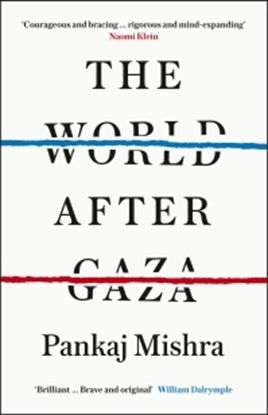
The World After Gaza
*WINNER OF A PALESTINE BOOK AWARD*
From the award-winning writer and thinker, an essential reckoning with the war in Gaza, its historical conditions, and moral and geopolitical ramifications
'Courageous and bracing, learned and ethical, rigorous and mind-expanding' NAOMI KLEIN
'Mishra has made a powerful contribution to the moral history of the world' ANDREW O'HAGAN
'Urgent' HISHAM MATAR
'Brilliant' WILLIAM DALRYMPLE
Memory of the Holocaust, the ultimate atrocity of Europe’s civil wars and the paradigmatic genocide, has shaped the Western political and moral imagination in the postwar era. Fears of its recurrence have been routinely invoked to justify Israel’s policies against Palestinians. But for most people around the world – the ‘darker peoples’, in W. E. B. Du Bois’s words – the main historical memory is of the traumatic experiences of slavery and colonialism, and the central event of the twentieth century is decolonisation – freedom from the white man’s world.
The World After Gaza takes the war in the Middle East, and the bitterly polarised reaction to it within as well as outside the West, as the starting point for a broad reevaluation of two competing narratives of the last century: the West’s triumphant account of victory over Nazi and communist totalitarianism, and the spread of liberal capitalism, and the global majority's frequently thwarted vision of racial equality. At a moment when the world’s balance of power is shifting and a long-dominant Western minority no longer commands the same authority and credibility, it is critically important to enter the experiences and perspectives of the majority of the world’s population.
As old touchstones and landmarks crumble, only a new history with a sharply different emphasis can reorient us to the world and worldviews now emerging into the light. In this concise, powerful and pointed treatise, Mishra reckons with the fundamental questions posed by our present crisis – about whether some lives matter more than others, why identity politics built around memories of suffering is being widely embraced and why racial antagonisms are intensifying amid a far-right surge in the West, threatening a global conflagration. The World After Gaza is an indispensable moral guide to our past, present and future.
Lees meer
The World Until Yesterday
The no. 1 bestselling author of Collapse and Guns, Germs and Steel explores the profound lessons that traditional societies offer us today
Over the past 500 years, the West achieved global dominance, but do Westerners necessarily have better ideas about how to raise children, care for the elderly, or simply live well? In this epic journey into our past, Jared Diamond reveals that traditional societies around the world offer an extraordinary window into how our ancestors lived for the majority of human history - until virtually yesterday, in evolutionary terms. Drawing on decades of his own fieldwork, Diamond explores how tribal people approach essential human problems, from health and diet to conflict resolution and language, and discovers they have much to teach us.
Jared Diamond is the Pulitzer Prize-winning author of the seminal million-copy-bestseller Guns, Germs, and Steel, which was named one of TIME's best non-fiction books of all time, and Collapse, a #1 international bestseller. A professor of geography at UCLA and noted polymath, Diamond's work has been influential in the fields of anthropology, biology, ornithology, ecology and history, among others.
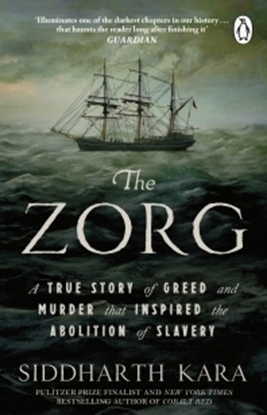
The Zorg
A WATERSTONES PAPERBACK OF THE YEAR 2026
'A horrific tale of the slave trade, destined to become a classic' New York Times
* History Writers Association Non-Fiction Crown Longlist 2026
* PEN Literary Award Finalist 2026
* New York Times 100 Notable Books of 2025
* Time’s 100 Must Read Books of 2025
* The New Yorker 12 Essential Non-Fiction Reads 2025
From the author of New York Times bestselling and Pulitzer Prize Finalist Cobalt Red, discover the shocking true story and riveting account of the 18th century slave ship whose journey from the high seas to the High Court sparked the human rights campaign to end the slave trade. Perfect for fans of David Grann's The Wager and The Wide, Wide Sea by Hampton Sides.
In 1781, the Zorg set off from the Netherlands to buy slaves in West Africa to sell in the Caribbean. By the time its journey ended, the Zorg became the first undeniable argument against slavery.
When a series of unpredictable weather events and navigational errors led to the Zorg sailing off course and running low on supplies, the crew's solution was to throw more than a hundred slaves overboard in order to save themselves and the most valuable slaves. The ship's owners then claimed their loss on insurance.
The insurers refused to pay the claim due to the unusually high mortality rate of the slaves on board, leading to a trial which initially found in favour of the ship's owners, with the slaves equated to horses with a compensation value of £30 per slave. Due to the outrage of one man present in court that day who wrote an anonymous letter to the press objecting to the result, a retrial was held.
For the first time, concepts such as human rights and morality entered the discourse on slavery in a courtroom case that boiled down to a simple yet profound question: Were the Africans on board people or cargo?
In this riveting book, bestselling author and Pulitzer Prize finalist Siddharth Kara brings the true horror of the Atlantic slave trade to life.
The case catapulted the emerging anti-slavery movement to one of the most consequential moral campaigns that changed the course of history.
Lees meer
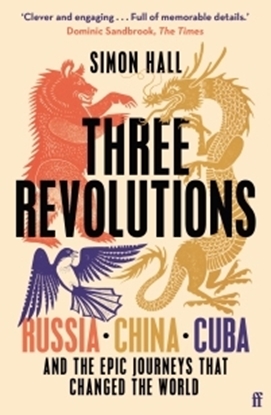
Three Revolutions
'Clever . . . Full of memorable details.' DOMINIC SANDBROOK, THE TIMES (HISTORY BOOK OF THE YEAR)
'An engaging story of political odysseys.' TIMES LITERARY SUPPLEMENT
'A salve for our current reactionary times.' ANDREW HARTMAN
The gripping, untold story of how six epic journeys launched the three communist revolutions that changed world history forever.
From the streets of Petrograd during the heady autumn of 1917, to Mao’s stunning victory in October 1949, and Fidel’s triumphant arrival in Havana, in January 1959, the history of the twentieth century was transformed in dramatic and profound ways by the Russian, Chinese, and Cuban revolutions.
In Three Revolutions, the stories of these epoch-defining events are told together for the first time. At the heart of each revolution was an epic journey: Lenin's 1917 return to Russia from exile in Switzerland; Mao's 'Long March' of 1934–35, covering some 6,000 miles across China; and Fidel Castro's return to Cuba in 1956 following his exile in Mexico. Told in tandem with these are the corresponding journeys of three extraordinary journalists – John Reed, Edgar Snow and Herbert L. Matthews – whose electric testimony from the frontlines of each revolution would make a decisive contribution to how these revolutions were understood in the wider world.
Here, in Simon Hall's masterful retelling, these six remarkable journeys are brought vividly to life. Featuring a stellar cast, extraordinary drama and an epic sweep, Three Revolutions raises fundamental questions about the nature of political power, the limits of idealism and the role of the journalist - questions that remain of utmost urgency today.
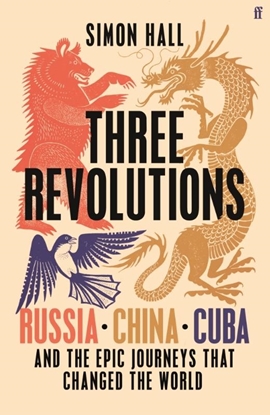
Three Revolutions - export ed. Faber & Faber
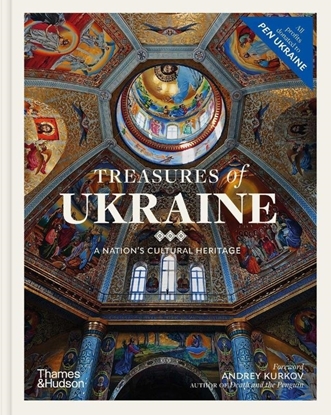
Treasures of Ukraine
Treasures of Ukraine chronicles the arts and heritage of Ukraine at a time when the country’s people, culture, landmarks, and artworks are facing destruction and devastation. Created in partnership with a group of renowned artists, curators, and critics, this record of architectural monuments and artworks reaches from prehistory to the present day.
Organized chronologically across eight chapters, Treasures of Ukraine contains more than 220 color images that showcase everything from Scythian gold, Byzantine icons, and wooden churches to gold-domed cathedrals, avant-garde masterpieces, and political art after the Orange Revolution, while accompanying texts reveal the history and significance behind the pieces. Examples of vernacular art weave Ukraine’s dynamic and inextinguishable folk narrative through the book, providing visual texture as well as a sense of the nation’s living history.
This is a compelling account of Ukraine’s history, told through the prism of a carefully curated selection of key monuments, architectural landmarks, and works of art. All proceeds will go to PEN Ukraine, to help Ukrainian authors in need.
Lees meer
Very Short Introductions The Russian Economy
What the Greeks Did for Us

Women & Power

